Evening dress codes once operated with military precision. Black tie meant one thing, white tie meant another, and the rules left little room for interpretation. Today, the landscape has softened. Invitations arrive with phrases like "festive cocktail," "elegant casual," or simply "dress up," and the old certainties no longer apply. This shift has not made evening dressing easier — it has made it more personal. The modern approach to after-dark dressing demands a new kind of fluency, one that balances occasion, environment, and individual style without the safety net of rigid prescription.
Reading the Modern Invitation
The first skill of evening dressing is interpretation. Before selecting a garment, you must decode the event. The venue, the host, the time, and the stated dress code all provide clues, but none should be read in isolation. A gallery opening at eight in the evening calls for something different than a seated dinner at the same hour, even if both invitations say "cocktail." Consider the context as carefully as the words.
When the Code Is Stated
Black tie remains the most formal instruction, and it still means a floor-length gown or a sharply tailored tuxedo. The modern concession is that the gown need not be black — jewel tones, deep metallics, and even ivory are now acceptable within the black-tie framework. Cocktail attire has broadened the most. Once a knee-length dress, it now encompasses everything from a midi-length slip to a tailored jumpsuit. The unifying principle is polish: the garment should feel deliberate, refined, and distinct from daytime wear.
When the Code Is Vague
"Dressy casual" and "festive" are the most challenging instructions because they invite personality while demanding restraint. The safest approach is to elevate a single element. A well-cut pair of trousers paired with a silk blouse and a statement earring reads as considered without tipping into overdone. A midi dress in a rich fabric — velvet, silk crepe, or satin — works across nearly every vague dress code. When in doubt, err on the side of structure. A garment with architectural lines always looks more evening-appropriate than a soft, unstructured piece, regardless of fabric.
Fabric and Finish: What Signals Evening
More than silhouette, it is material that distinguishes evening wear from day. The same shift dress in cotton poplin reads as daytime; in silk charmeuse, it becomes evening. Understanding which fabrics carry after-dark authority allows you to build an evening wardrobe from pieces that might otherwise read as ordinary.
The Evening Fabric Vocabulary
Silk in its various forms — crepe de chine, charmeuse, and satin — is the foundation of evening dressing. It catches light in a way that signals occasion. Velvet adds depth and texture, particularly in deep tones like midnight blue, burgundy, or forest green. Metallics, once reserved for the most formal events, now appear across the evening spectrum, from a subtle lame thread woven through a knit to a fully sequined gown. Lace, when used with restraint, adds a romantic dimension. The key is to choose one evening fabric as the focal point rather than combining several, which can read as costumey.
The Role of Finish and Detail
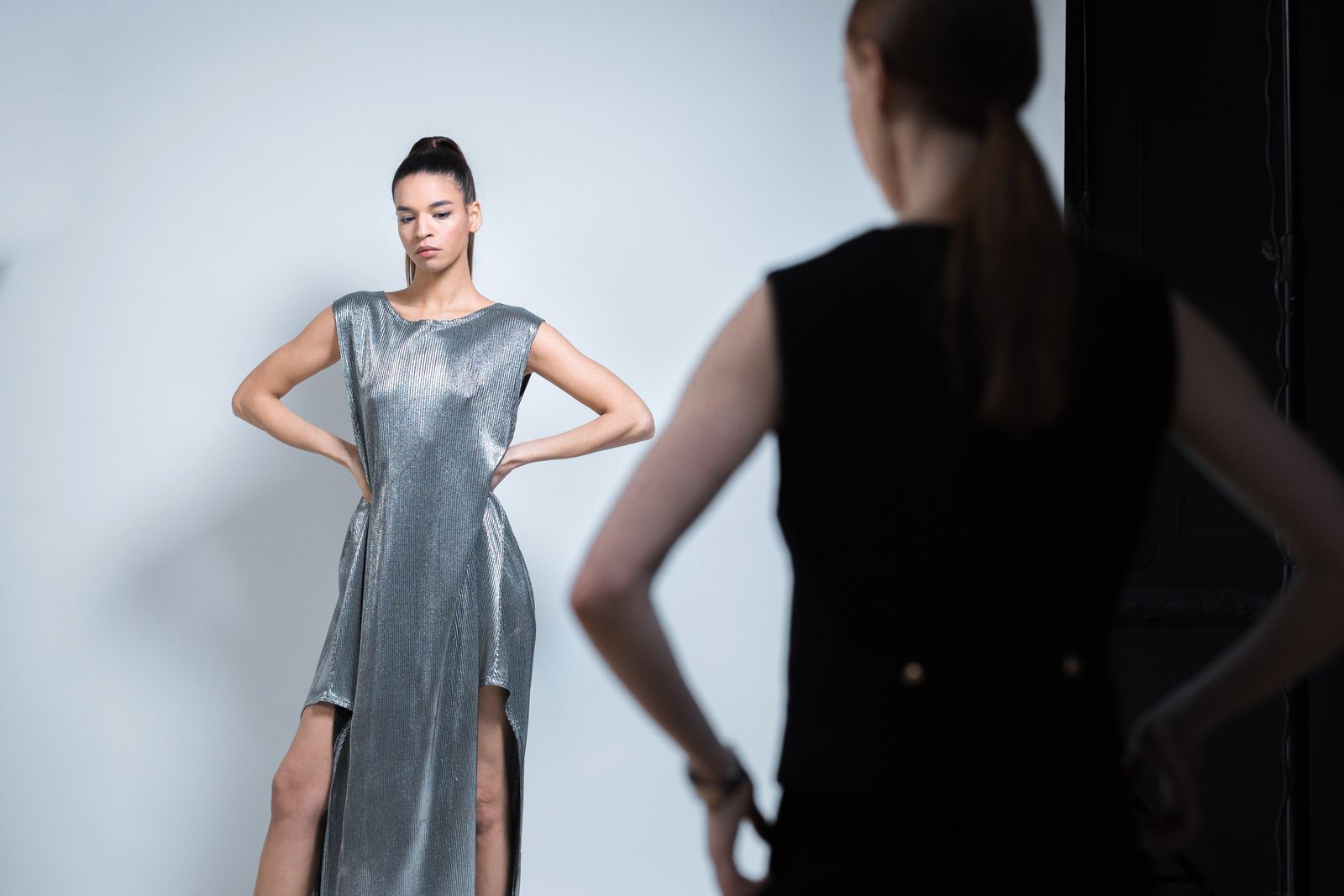
Evening garments distinguish themselves through finish as much as fabric. A higher hemline that would be casual in cotton becomes deliberate in silk. Draping and asymmetry — details that might look fussy in daywear — read as elegant after dark. Beading and embellishment should be concentrated in one area rather than scattered, creating a focal point rather than a uniform sparkle. The most sophisticated evening pieces often rely on a single dramatic detail: an open back, a draped neckline, or a thigh-high slit in an otherwise understated garment.
Building an Evening Wardrobe
An evening wardrobe does not require dozens of pieces. Five carefully chosen garments can cover nearly every after-dark occasion. Begin with a floor-length gown in a neutral or jewel tone — this is your black-tie answer. Add a midi-length dress in a rich fabric for cocktail events. A tailored jumpsuit in black or deep navy handles occasions that call for polish without a dress. A silk blouse in ivory or champagne elevates trousers for dressy-casual events. Finally, a statement skirt in metallic or sequined fabric pairs with simple tops for festive occasions. Together, these five pieces form a matrix that, with different accessories and styling, can address nearly any evening invitation.
Accessories: The Evening Signature
Accessories carry more weight in evening dressing than in any other context. A simple black dress becomes entirely different with a chandelier earring versus a single pearl drop. Evening accessories should be deliberate: one statement piece is almost always more effective than several smaller ones. A metallic clutch, a pair of embellished heels, and a single bold piece of jewelry — rotated, not combined — are the tools that transform a garment into an evening look. The modern approach favors restraint. Let one element shine, and let the rest provide quiet support.
Evening dressing, at its best, is an opportunity rather than an obligation. The relaxation of rigid codes has given us permission to bring more of ourselves to the occasion. The goal is not to follow rules but to develop the judgment that makes rules unnecessary — to read the room, choose the fabric and silhouette that match the moment, and add the single detail that makes the look unmistakably yours.